Monday, January 14, 2008

Reliance petrol pumps and A1 Plazas

A Reliance A1 Plaza
Any motorist who is fond of long drives and has driven in India along with his family must have experienced the woefully inadequate toilet facilities along the Indian highways. While for Indian men the whole country is one large open toilet, women find long drives problematic. Very few dhabas (roadside eateries) have toilets. All new petrol pumps of PSU oil companies (like HPCL, BPCL, IOL, etc.) do have toilets but usually they are in such a horrible condition that one feels like throwing up.

In this scenario, the Reliance petrol pumps have arrived like a breath of fresh air. Their toilets are usually clean, always have water and the flushes actually work. They even have liquid soap dispensers! Furthermore, all Reliance petrol pumps have water coolers fitted with Aquaguard water purification systems.

My family and I have been using the Reliance petrol pumps (BTW, only for the toilet and drinking water facilities; the fuel, especially diesel, is much costlier) ever since they started coming up along the highways. Each and every Reliance petrol pump has an identical design / layout and that makes things even more convenient for the motorist.

Of late, some of the bigger Reliance petrol pumps along the highways are offering the additional convenience of ‘A1 Plaza’ which serve food as well. Apart from a large dining hall, A1 Plazas have family dining rooms too. They also have TV's, conference rooms with digital projection facilities, bigger toilets and facilities for taking bath.
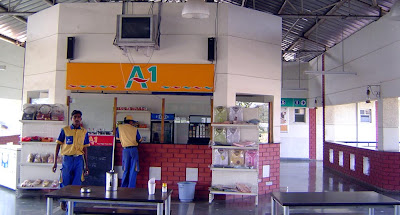
Sales counter inside A1 Plaza

My wife and I always look out for Reliance A1 Plazas during our long drives -- especially at meal times. They offer a decent choice of food – both veg and non-veg. Prices are quite reasonable. Cold drinks, ice creams, snacks, etc., are also available.

An open kitchen inside A1 Plaza


A poster inside A1 Plaza

Overall performance of my Swift VDi during Jamshedpur-Bombay-Jamshedpur trip

Once again, my Swift VDi exceeded my expectations during this long drive of 4450 km (Jamshedpur – Bombay – Lonavla – Bombay – Sambalpur - Brajrajnagar - Sambalpur - Jamshedpur).

The car was completely trouble free and 100% reliable during this long drive, as any self-respecting modern car should be. Additionally, my Swift VDi was a pleasure to drive both at high and low speeds – thanks to a jewel of a diesel motor which produces peak torque at only 2000 RPM and is highly responsive over its entire power range.

There were hundreds of kilometres of bad roads on the way and the suspension took it fairly well. The suspension is definitely better than that in my previous car (Maruti Esteem). There were a few ‘bottomings’ of the front suspension (while hitting unmarked speed-breakers, for instance) and the metallic sound given out by the front suspensions during such bottomings was pretty jarring. When I heard that metallic clang for the first time I was quite alarmed but subsequently I discovered that the clang from both the left and right front suspensions was identical. Anyway, I must probe further into the root cause of this metallic clang.

Another little flaw was a couple of minor body noises – apparently coming from the doors.

Driving the car at 160 kmph on the Lonavla-Bombay expressway was pure ecstasy. There were 4 adults plus weekend luggage in the car and the AC was on when I touched 160 kmph quite effortlessly.

The climbing ability of the car, even in higher gears at relatively low speeds, is excellent. It was a very pleasant new experience (as compared to my earlier petrol cars) for me to drive my new baby on the numerous ghat stretches in Maharashtra and Orissa.

And once again, the icing on the cake was the phenomenal mileage figures. Overall mileage obtained over this entire 4450 km trip (including city driving in / around Bombay and Bombay – Lonavla – Bombay trip) was 24 kmpl. If city driving and Lonavla trip are excluded, the mileage comes to 25.5 kmpl. The best mileage measured (over a distance of 890 km between Nagpur and Bombay) was 26.56 kmpl. AC use was around 50%. Non-premium diesel was used.

Can one ask for more?

Bombay to Jamshedpur in 4 days

Jaya and I started from Bombay on 05.01.08 and reached Jamshedpur on 08.01.08, covering a total distance of 1988 km over 4 days. En route we also visited a relative at Brajrajnagar (60 km from Sambalpur in Orissa) which increased the distance by 120 km. My Swift VDi again performed superbly during this drive. Brief day-wise details as follows :

Day 1 (05.01.08)

Started from Thane at 5.30 AM and reached Khamgaon (529 km from Thane) around 6 PM.

From Thane it did not take much time to reach Bhiwandi as this stretch is a 4-lane dual carriageway. But I had to drive very slowly and cautiously after the dual carriageway ended at Bhiwandi because it was still dark and the highway did not even have the white lines on the edges. As is common in India, many oncoming vehicles continue using high-beam while passing you and one gets momentarily blinded. Luckily, the major ghat (hill) stretches started after daybreak.

Parasnath Jain temple at Nashik

Day 2 (06.01.08)

Started from Khamgaon at 8 AM and reached Rajnandgaon (Chhattisgarh) around 7 PM, covering a distance of 527 km.

Gigantic statue of Hanuman along NH6 at Nondura (Maharashtra)

Day 3 (07.01.08)

Started from Rajnandgaon at 7 AM and reached Brajrajnagar (Orissa) at 5 PM, covering a distance of 405 km.

Brajrajnagar, where we paid a brief visit to a cousin of mine, is not situated along the main highway (NH6). One has to turn off northwards towards Jharsuguda from Sambalpur and drive for 60 km to reach Brajrajnagar. This stretch (constructed by L&T a few years ago) is very good and one can safely do 100-120 kmph. As the roads in Orissa between the Chhattisgarh border and Sambalpur are quite painful, this L&T road was a welcome break!

Day 4 (08.01.08)

Started from Brajrajnagar at 6 AM and reached home (Sonari, Jamshedpur) at 7 PM, covering a distance of 527 km.

Wednesday, December 26, 2007

Driving lessons on my Swift VDi

During our family holiday at Lonavla, I gave some driving lessons to my wife and younger daughter at a deserted spot near the Sunset Point at INS Shivaji. We found something very interesting about the car, which I must share.

The deserted spot near Sunset Point at INS Shivaji. Duke's Nose visible.

For a beginner, the co-ordination between clutch and accelerator is most tricky while trying to set the car in motion. The reason is that when one releases the clutch, load comes on the engine and its RPM falls, tending to stall it. To prevent stalling, one has to gradually rev the engine by gently pressing the accelerator while releasing the clutch. To our pleasant surprise, we found that one can set a diesel Swift in motion by simply releasing the clutch (without even touching the accelerator). The technical reasons for this, as I figure, are :

a) Due to high torque of the Swift diesel engine at low RPM, even at idling RPM (about 800) the engine is able to pull the car at low speed.
b) The accelerator of the Swift diesel is completely electronic (‘drive-by-wire’ technology) and does not involve any mechanical linkages or cables. As you press the gas pedal you are merely turning a potentiometer (or something of that sort) and sending an electronic signal to the on-board computer. At idling (when the pedal is at zero position) the computer controls the idling RPM, and it is probable that even when some load is put on the engine the computer tries to maintain the set engine RPM by increasing the fuel input.

Whatever be the technical reasons, the bottomline is that even for a child it is as easy as apple pie to set a diesel Swift in motion. The fact that the clutch is very very smooth and effortless also helps.

Sunset as seen from the Sunset Point, INS Shivaji

160 kmph on the Lonavla – Bombay expressway

Approaching Lonavla

I drove from Bombay to Lonavla and back with my wife and two daughters during the X’mas holidays in 2007. We had a wonderful stay at INS Shivaji at Lonavla, did a fair bit of trekking (climbed the Duke’s Nose peak), relived wonderful memories of INS Shivaji / Lonavla / Khandala with my family (we lived there from 1988 to 1990) and met up with my oldest friend Mr. N. Bezbora (86 years young and a great man) and his family at Lonavla town.

Mr. N. Bezbora and I at his lovely garden


Inside INS Shivaji -- Duke's Nose visible at background

And yes, I also enjoyed some great driving on my Swift VDi on the Bombay-Poona Super Expressway.

Why do I call this expressway ‘Super’? Because, unlike most expressways (including the Golden Quadrilateral) in India, this one is almost entirely 6-laned and since the ‘up’ and ‘down’ roads (each 3-laned) are completely segregated (with no interconnecting ‘cuts’), one does not find vehicles moving in the wrong direction. Also, the road is well-barricaded and passes through uninhabited terrain and therefore one does not usually find stray animals or humans loitering on the road. No autorikshas, cycle-rikshas or hand-carts either.

At the Naval College of Engg. inside INS Shivaji -- one of INS Vikrant's propellers (14 ft dia, 9550 kg) visible

The only problem I found on the expressway was several slow-moving (relatively) cars hogging the fast lane and forcing you to either slow down and honk or to overtake them from the left. But even in this respect I found the lane discipline significantly better than most other places in India. Drivers doing 80 to 100 kmph in India often think that they now deserve to be in the fast lane. Little do they know of the scorn with which drivers of superior vehicles moving at 150 kmph or more view them.
Duke's Nose -- as seen from the expressway

I just had to try out my new toy at its max rated speed of 160 kmph and the Bombay – Poona road provided the best opportunity. During our onward journey we started from Bombay at 5 AM (to avoid city traffic) and found ourselves at Lonavla just after sunrise at 7 AM. Since it was dark almost throughout, I did not attempt anything more than 120 kmph. While returning, we started at 10 AM and just after crossing the ghats and descending to level ground at Khopoli I started looking for opportunities to speed up. Finding a long straight stretch where I could see the road clearly for several km, I stepped on the gas and reached 160 kmph quite effortlessly. The car felt absolutely stable and steady and the hum of the engine (whatever was audible above the wind and ground noise) was sweet music to my ears. Though there were 4 of us (plus luggage and half tank of fuel) in the car and AC was on, the engine was clearly ready to exceed 160 kmph and might have gone up to higher speeds. But my 56 years of age caught up with me and I decided not to try higher speeds, having achieved my target of 160 kmph (100 miles per hour). Subsequently, I touched 160 kmph on two more occasions during this drive. What a great way to celebrate Christmas with my family (it was 25.12.07)!

After touching 160 kmph for the third time, I pulled over at a safe spot and felt the temperature of my tubeless radials by hand. They were satisfactorily warm (not hot) and the front tyres were warmer than the rear ones. The time was around 11 AM.

I must add that when I pulled over to check tyre temperature after doing 160 kmph, I did not stop the engine but let it idle. This is very important because turbochargers become very hot at high power and they must be allowed to cool down gradually. If one abruptly stops the engine (thereby stopping oil circulation) after doing high speeds / power, lubricating oil at the turbo may burn and cause damage.

Prior to this, I had done 160 kmph only once before in my life – in March 2003 I had driven my friend Cdr Gopalkrishna’s Hyundai Accent Viva and reached that speed. Interestingly, that drive too was on this very same Bombay – Lonavla stretch of this super expressway. Needless to say, doing 160 kmph on my own car (finally!) was more gratifying.

Thursday, December 20, 2007

Awesome mileage of 26 kmpl from my Swift VDi– using non-premium diesel

During my Jamshedpur – Kolkata - Delhi – Jamshedpur drive, I got a fuel efficiency of 21.2 kmpl overall (on a certain stretch I had measured 24 kmpl). So how come I got 26 kmpl overall (Jamshedpur to Bombay) now?

a) Engines (especially turbocharged & intercooled diesels) have much greater efficiency at low ambients. During this trip in winter the average ambient temperature was lower. I generally started every day at around 5 AM which gave me more time at lower temperatures.
b) The average speed during this trip was substantially lower (70-90 kmph as against 90-120 kmph during the Jamshedpur – Kolkata - Delhi – Jamshedpur drive. This probably is the most important contributor to the high fuel efficiency.
c) The use of AC was minimal (around 25%).
d) The fact the engine has now been properly run-in must have helped too.
e) My Jamshedpur – Kolkata - Delhi – Jamshedpur drive included quite a bit of city driving.

I must highlight the fact that an individual’s driving style greatly affects fuel consumption. Usually, I don’t accelerate or decelerate too rapidly, keep use of brakes to a minimum and try to drive at a steady speed on highways.

How do I calculate fuel consumption?

I take a lot of care in calculating fuel consumption because this is the single most important indicator of engine health. I note down the odometer reading whenever the fuel gauge needle is exactly aligned with the ½ tank mark. Next time the needle comes to the ½ mark, I again note the odometer reading and calculate the mileage by dividing the difference by the amount of fuel filled since the earlier reading.

Jamshedpur to Bombay in 4 days

Jaya and I started from Jamshedpur on 16.12.07 and reached Bombay (Jogeshwari West) on 19.12.07, covering a total distance of 1905 km over 4 days. The Swift VDi performed amazingly during this drive and gave me a mileage of 26 KMPL over this entire distance. Brief day-wise details as follows :

Day 1 (16.12.07)

Started from Jamshedpur at 6 AM and reached Sambalpur (471 km from Jam) around 5 PM.

From Jam, took the narrow road via Jadugora (Uranium mines) to reach Moubhandar because the stretch of NH33 between Jam and Moubhandar continues to be in a horribly dilapidated state. From Moubhandar to Bahragora the highway (NH33) is generally OK, with many newly resurfaced good stretches interspersed with some short terrible ones (probably to remind the motorist that one is still in Jharkhand).

The narrow Jadugora road is BETTER than some stretches of National Highway 33!

After entering Orissa through the Jamshola border, I found the Orissa roads (NH6) to be much better than Jharkhand but some poorly maintained stretches (around 5%) are there where one has to slow down. There are a few ghats (hill roads). The most striking feature of the 360 km stretch of NH6 between Jamshola border to Sambalpur is that there is very little human habitation along the road which passes mostly through dense forests. One sees very few people, and for this reason I think this stretch is best avoided at night.

Day 2 (17.12.07)

Started from Sambalpur (Orissa) at 4.30 AM and reached Nagpur (Maharashtra) around 5 PM, crossing the state of Chhattisgarh en route. This was the longest distance (557 km) traversed over a single day during our Jamshedpur-Bombay drive.

The stretch in Orissa between Sambalpur to the Chhattisgarh border (90 km) is not good, with lots of cracks and shallow craters on the road surface. The 300 km NH6 stretch through Chhattisgarh is very good (includes the excellent 4-lane Raipur-Bhilai-Durg toll road). However, due to heavy local traffic, one cannot do high speeds on the Raipur-Bhilai-Durg stretch.

At a temple gate in 36-garh

After entering Maharashtra, the 170 km to Nagpur is excellent. This gave me hope that all roads in Maharashtra would be equally excellent, but I found on day-3 that Maharahtra has bad roads too.

Day 3 (18.12.07)

Started from Nagpur at 7 AM and reached Jalgaon at 5 PM, covering a distance of 447 km.

The road surface on most of this stretch of NH6 is not good (with shallow craters) and one has to restrict the speed to around 80 kmph unless one’s suspension is covered by an unlimited warranty. However, there are a few excellent stretches like that Amravati bypass.

At a Reliance A1 Plaza along the highway -- early in the morning


Between Nagpur and Talegaon, 4-laning is going on. Road improvement is also going on at many other places along this route. Things are definitely getting better for Indian motorists.

A major problem (which continued right up to Bombay) is the high truck traffic density in Maharshtra. One has to keep slowing down to overtake trucks (whenever traffic headed towards you allows you) Affects one’s average speed.

Day 4 (19.12.07)

Started from Jalgaon at 4.45 AM and reached Bombay (Jogeshwari West) at 3 PM, covering a distance of 423 km.

Ab Bombay door nahin! Near Nashik.


Road (NH6) from Jalgaon to Dhule is quite good. At Dhule, one turns left into NH3 and comes across big ghat stretches till Nashik (and beyond). 4-laning is going on almost all along. Despite the good road surface, one cannot consistently do high speeds due to too many bends / curves (due to hilly terrain) on the road and excessive truck density.


After Bhiwandi, there is excellent 4-lane expressway till Thane / Bombay.

Overall impression

The 1905 km drive from Jamshedpur to Bombay reinforces my belief in the ‘India Shining’ story. Road surfaces have improved a great deal over the last 10 years. People everywhere appear more affluent.

My Swift VDi has performed superbly. I could overtake most vehicles on the highways with ease, including on the ghat stretches. Actually, the performance of my diesel Swift on the steep inclines on the hill stretches impressed me the most. On inclines where my Maruti Esteem would have required 2nd gear, I climbed effortlessly in 4th. And an overall mileage of 26 kmpl (measured accurately over the entire distance of 1900 km) is truly awesome.